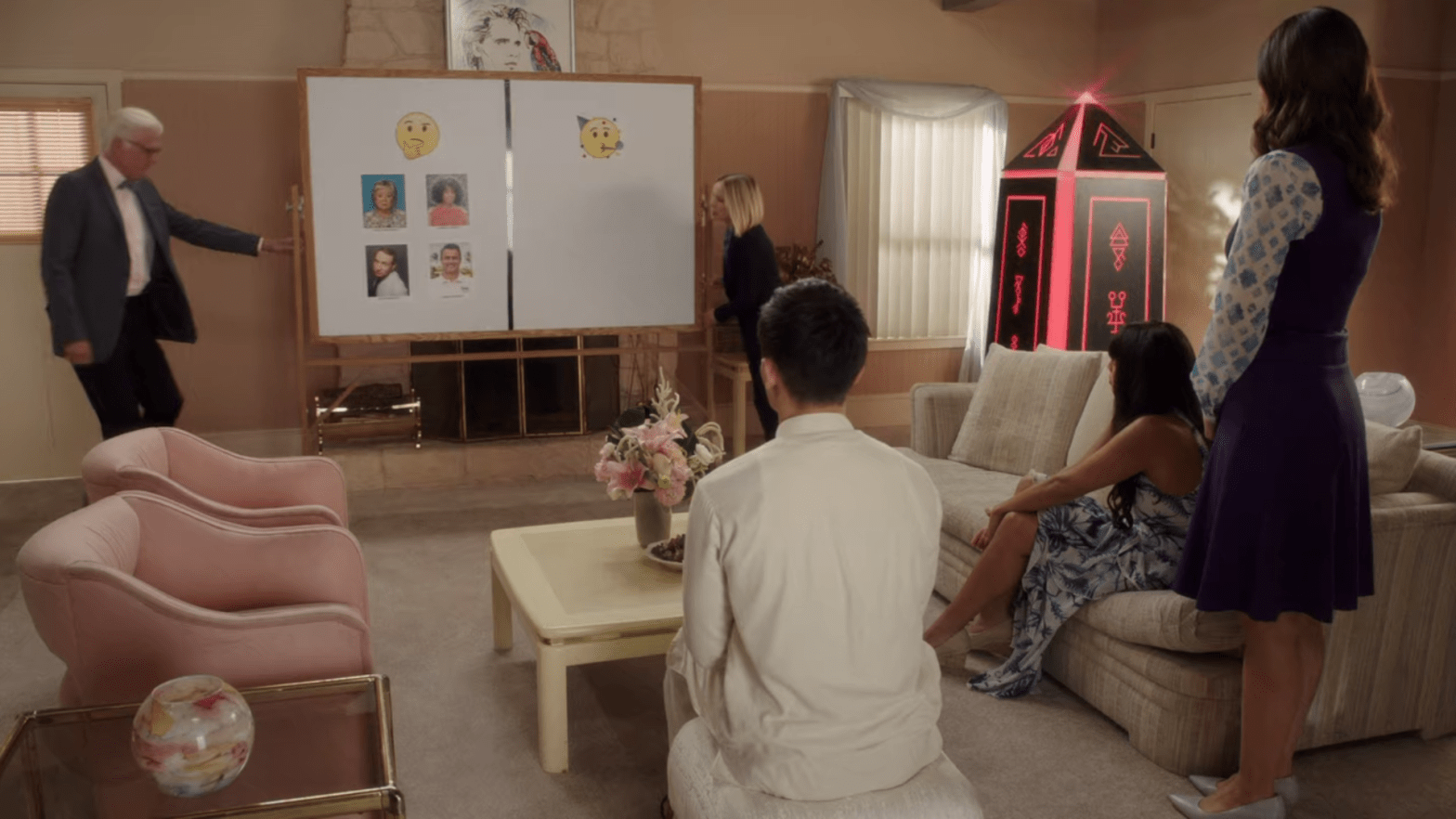
The Good Place offers to its audience a unique interpretation of the afterlife, particularly focusing on the utopia that is rewarded to those that have led a righteous life – what is known as The Good Place. Season 4 is a continuation of the story line in which Eleanor, the series’ protagonist, poses as The Good Place’s architect who runs all background operations for four new residents in an attempt to save all of humanity from spending eternity in The Bad Place. The first episode of season 4 provides the framework for what is to follow, establishing the challenges that must be overcome in order for Eleanor and her friends to succeed in saving the ‘broken afterlife system’. This critical review will examine and analyse various filming techniques used and the effect that they have in the first episode of season 4 of The Good Place, titled A Girl From Arizona – Part 1.
The episode commences with a prolonged close-up shot of Eleanor’s face reacting to Chidi’s first comments of ‘heaven’. The intimacy created from the close proximity of the shot establishes a close relationship between her and the audience. We are unable to see Chidi and can assume that he is in eye sight of Eleanor due to the fact that she is looking behind the camera; however, after several comments of happiness remarked by Chidi, we see Eleanor turn to her left to acknowledge him. The camera then briefly switches to a mid-shot of both Chidi and Eleanor where it is revealed that she is staring into the distance with a posed smile. This is then emphasised by a long-shot which positions the small figures of Eleanor and Chidi in the centre of the screen as the residents go about their business around them. From here, we are able to see the instability and conflict that is occurring within Eleanor as she endures Chidi’s first comments and struggles to maintain the ‘Architect’ act. She remains motionless and can be interpreted as temporarily broken as a result of Chidi’s comments – obviously distraught by his lack of memory of her and the relationship that they had. The episode has barely begun, and the audience is already feeling sympathy for the strength and selflessness that Eleanor maintains as well as the sacrifices that she has made.

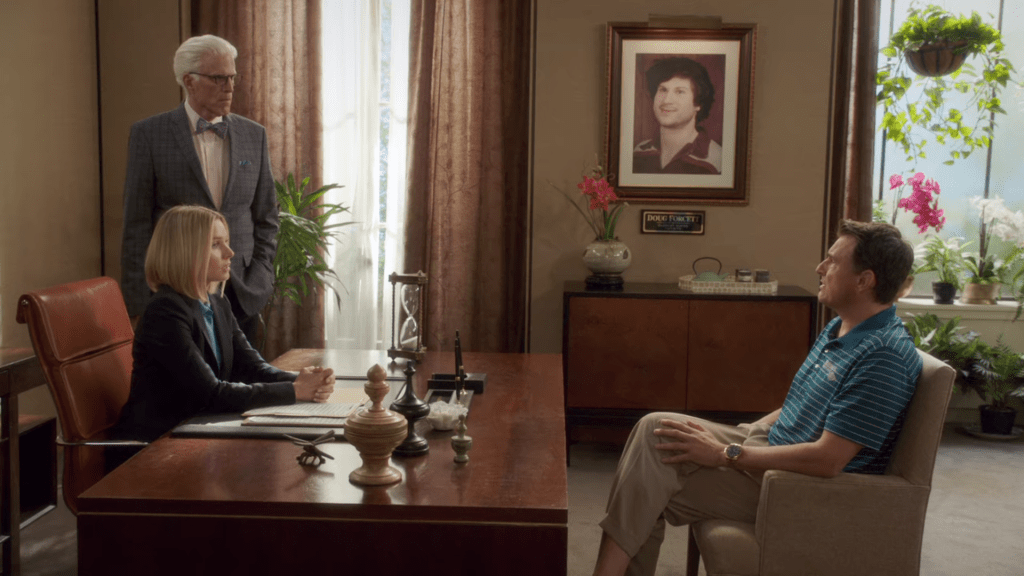
After the arrival of Linda Johannsen, who is portrayed to be the most boring person of all time, Eleanor and Michael receive another resident by the name of Brent Norwalk. After the initial surprise of Linda Johannsen, we are again amazed when the character is portrayed to be a snobby, wealthy, middle-aged, white-privileged, obnoxious businessman who plays golf. After he wakes up in the Good Place and is informed that he is dead, the first time he speaks and reacts turns into a long rant about the troubles he was in when he was alive because of comments he had made and assures Eleanor and Michael that he is not racist (even though he clearly is). During his long rant, which is totally unexpected by Eleanor and Michael, the music which usually plays throughout the show as background noise is cut out. The scene become silent and all focus is placed on Brent. The effect of the music cutting out is representative of the initial shock that Eleanor, Michael and, more importantly, the audience, experience. The silence creates dramatic tension as no one knows how to react to the absurdity and unusual nature of the character. During his rant, the scene is filmed primarily with a close up of Brent’s face with one brief cut to Eleanor and another to Michael as they react to Brent’s rant. After his rant and his demand to know where he is, the camera cuts to a side mid-shot shot of the three of them. The distance between Eleanor and Michael from Brent as well as their inability to speak creates comedy in the scene. There is a long pause and cessation of all sound until Michael is able to reply with “the Good Place” – which creates comedy in the fact that everything Brent spoke of sounded “bad.”
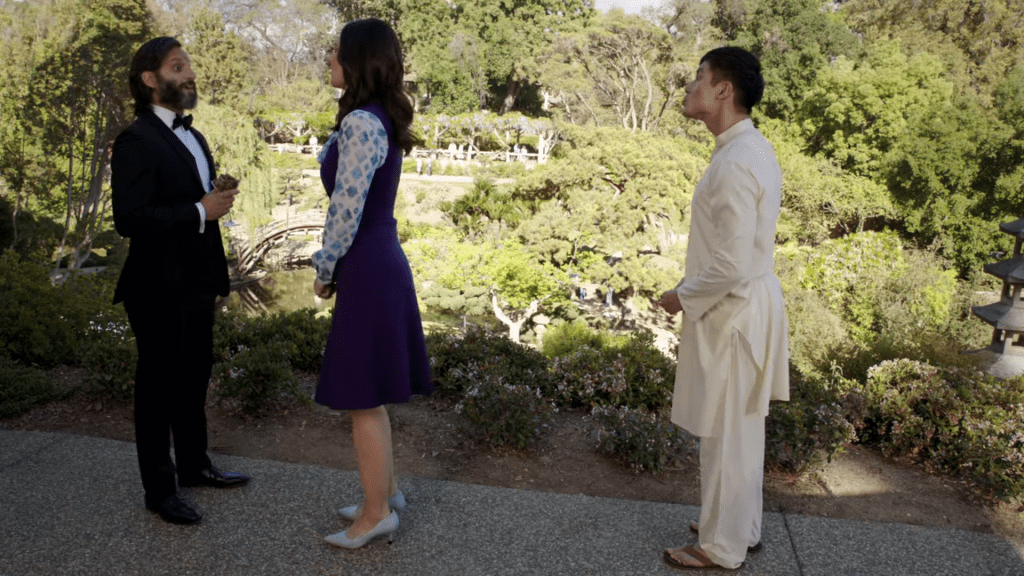
It’s not just camera positions that have been carefully chosen for the purposes of advancing the story. Mise-en-scenes is an excellent tool in film making as it provides an opportunity to reveal more information than can be received from what is said. Moura (2014), states that mise-en-scene can help the director to “determine the look and feel intended.” For example, one shot which involves the characters Janet, Jason and Derek, portrays to the audience greater meaning behind the dilemma that Jason finds himself in. The position of the camera portrays to the audience Jason and Derek standing on a concreted ledge above the other residents of The Good Place who are all in the distance mingling with nature. The shot encompasses the concreted floor as it shows that they are separate from the others and not living in the ‘paradise that others seem to be living in. Additionally, they are both standing in the shade of a large structure, which covers them in darkness while everyone else in the background are showered in the suns light. This also symbolises the Jason’s dilemma and emphasises his feelings of hurt, disappointment and anger towards Derek, while others are in a state of ‘eternal happiness’. When Janet appears, Jason’s feelings are again highlighted when Janet is closer in proximity to Derek than she is to Jason. Janet’s back is faced to Jason and all of her attention is directed towards Derek while Jason is left separated from the two. Additionally, Derek is dressed in all black while Jason is dressed in complete white. Not only does this make the audience sympathise with the ‘good’ character Jason, but it also makes us see that he is in Derek’s dark shadow as he is in Janet’s favour – Jason is left sad, alone and jealous.
Another technique which creates dramatic tension and heightens the intensity of the scene for the audience is editing, more specifically, cuts. This can be particularly effective in moments of tension and excitement by utilising quick, fast-paced cuts to action. The Good Place exhibits this technique when Linda Johannsen, a supposed elderly resident, punches Eleanor and Michael in the face before attacking several more residents. It is the first act of physical violence portrayed in the show and catches the audience and the characters completely off guard. Before the action kicks off, the camera cuts are spaced out and relatively smooth. The transitions then change to match the action of the characters and, as soon as Linda punches Eleanor, a series of quick cuts ensues. Due to the intense circumstances and amount of action in the scene, the five second period of punching various people has a total of 11 cuts. In all, Linda punches three people before kicking a fourth person into a fruit stand. The scene’s intensity is created by the character’s actions, but they are emphasised and heightened for the audience through the technique of editing. The quick changes to the action confuse and surprise the audience as much as Linda confuses and surprises the other characters.
Evidently, there are various filming techniques available to a production crew that can further develop the story as well as heighten or emphasise specific actions to achieve a certain effect. The Good Place manages to utilise various techniques in the creation of film to reel in an audience and maintain their interest throughout the show. Episode 1 of season 4 clearly demonstrates some of the techniques that can be used to create successful film and the choices made should be recognised and appreciated by the audience as part of what makes the show so brilliant and successful.
References
Moura, G. (2014). Mise-en-scene. Retrieved from http://www.elementsofcinema.com/directing/mise-en-scene-in-films/


 The Film's Effect