Directed by David Lynch
Released May 16, 2001
The relationship between film form and content is regarded as incredibly important in the film industry and David Lynch is notorious for exploring different film forms to achieve meaning in his productions. Mullholland Drive is an excellent example of this as it serves as a lens into the incredible individuality of the mind of Lynch but also because the film deliberately and consistently explores the relationship between form and content. Whether it’d be one complimenting the other or clashing with the other, each and every decision is purposefully made to create meaning in film.
From the very beginning of the film, an audience is able to understand that this isn’t going to be the usual film. This is due to the first few minutes of the film consisting of a dance in which there are multiple copies of people dancing within each other. There is bright purple coloured background, loud music and blurred white faces which can only be described as a confusing acid trip experience. This is accented by an adjoining scene in which the primary colour is black and a slow-paced car drives around at night before it turns into a murder attempt topped with the abrupt inclusion of a car crash. His method of creating opposites in colour, speed and sound is heavily prominent throughout the film. The two described scenes occurred at the very beginning of the movie and already an audience has been on a rollercoaster of a ride.
The style of filming, although there are moments which are evidently edited and unrealistic, is executed in a way which manipulates the audience to feel as if they are present in the scene being shot. This is attributed to the cinematic scenes in which there is a lack of non-diegetic sound, therefore creating a sense of intimacy and naturalism. The performance then becomes simply the actor and the noise that they make in the scene, for example, when Rita is running down a dark street and the only noise heard is the sound of her heels hitting the road. Once again, however, Lynch offsets this with the sudden appearance of bright white headlights and the loud noise of sirens. A particular scene in which the audience is able to be fully immersed in the world being presented is when Betty begins exploring her Auntie’s house. There is little noise heard, only incredibly detailed sounds of clothes rustling, and the camera often recalls to a position which depicts the perspective of Betty exploring the house. This combination of techniques puts the audience on edge as they wait for the intruder to be revealed in the house and this creates a sense of urgency and immersion.
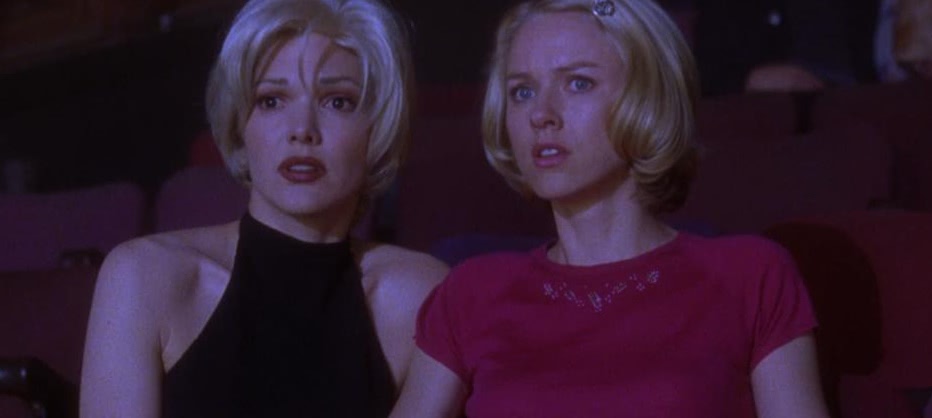
A curious element to the film is Lynch’s use of the distillation of imagery to represent a false reality. After a fair way through the film, the ‘dream’ that you have been watching is trying to break away and return to reality and this is evident through the relationship between content and form. Visual cues are provided to the audience, for example, the distillation of lights into the shapes of an ‘x’, the blurring of scenery and characters, cuts to darkness and fades in and out. In addition to this, we are also provided with audio clues into the state of reality in which the characters are in. During the scene in which they visit a theatre, a character literally says “it is all an illusion” which is a cryptic message to the audience that everything they have watched is not real and is actually a dream.
Overall Review
An excellent and highly intricate and detailed film which explores and challenges the relationship between film form and content. As an audience finally begins to piece the story together, Lynch literally destroys this reality and reveals that most of the movie was a dream; therefore, it can be interpreted to be lengthy and confusing, particularly to the average audience member. Mulholland Drive is a confronting masterpiece with elements which can terrify, excite, sadden, anger and completely immerse an audience into a film which presents a dark reality.
 The Film's Effect