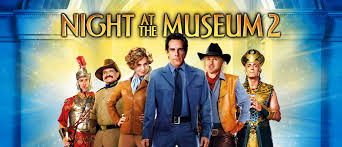
The actor’s costume contributes greatly to their portrayal of the character they are playing and can affect their performance in multiple ways. Due to the power of costume choice, a performance can change significantly after the introduction of costumes. As mentioned by Landis, “Costumes communicate the details of a character’s personality to the audience, and help actors transform into new and believable people on screen” (Landis, 2014, p. 2). Without the introduction of costume, a character’s full potential may not be recognised as costumes communicate to the audience so many important details of the character and the story. In a scene between Larry and Brundon from Night at the Museum 2, costume becomes a significant factor in determining how the scene will play out.
Larry is the security guard protagonist who features in all three films in the franchise. Brundon is the security guard of an alternate museum, the location of which this scene takes place. In an ironical sense, Larry, whom usually guards exhibits, is accused by Brundon of getting too close to the exhibits. As they are both security guards in their own museums, each having a sense of pride and ego about their positions, they are destined to have an altercation – essentially being replicas of one another. Both wanting to be of higher importance and status than the other, the scene can be summarised as: both having met their match.
Costumes provides great detail of who the character is and directly affects how the character is going to behave in a scene. According to Ripley (2014), “what we wear has two main purposes: function and expression.” The functional aspect is reflective of the occupation and location of the character, while the expressive aspect includes the denotation of status, class, allegiance, gender, sexual orientation, and personal opinion.
Focusing on Brundon, the audience is able to gain so much knowledge and information about the character simply by looking at his costume. Being the security guard of the museum, he is required to wear a uniform which is literally purposed to reflect his occupation to others. Brundon is instantly recognisable by visitors to the museum as well as to the audience as it is almost a direct replica of the costume which Larry has been required to wear whenever he is on the job. Straight away this portrays for Brundon a sense of status and authority, a position of which Larry is usually familiar with.
Analysing solely the script, it becomes clear that Brundon desires this status of importance and power. When Brundon sees Larry near the exhibit, he moves in to establish his dominance, accusing him of touching the exhibits without it actually happening. He becomes a bully, making various accusations and comparing him to a little girl. This could be reflective of some event that he experienced in the past when he was compared to a little girl. Throughout the entire scene, Brundon is constantly trying to come out on top and maintain that dominance and power; however, Larry is also taking it away from him. When Brundon is clearly in a position of defeat (when he is put into a headlock in the film), he still maintains his dominance without losing it by approving of Larry and not letting him apologise as it would seem Brundon’s conceit and loss of power. Brundon is a person who believes he is so important and powerful in his job and that others need to listen to him.
Wearing an appropriate costume can reflect how the actor plays the character in the scene. For example, as Brundon’s status is clearly portrayed to the world, the attitude he has towards Larry at the beginning of the scene can be of a relaxed state. This reflects his confidence and sense of importance, meaning that he does not have to do much work to feel overpowering towards Larry. Instead, he can let the words and the costume do most of the talking – directly reflecting the character and affecting the actor’s performance.
A key feature of the scene is Brundon’s torch; initially holstered, it becomes a weapon to threaten Larry. In Ripley (2014), it is mentioned that:
“Nearly every job comes with its own tools. How those tools are carried is dictated by need and practicality.”
This must be a considered part of costume design as it becomes prominent object in the scene. Brundon begins the scene being verbally and physically subtle about his position but, when he feels his power slipping away, he becomes more assertive, using his costume and status more directly. The way in which the character’s torch is positioned, where he holsters it and how he holds it all reflect how Brundon sees himself. On Brundon’s line (in the film) “I don’t know Princess Jasmine, am I?”, the character displays for Larry his holstered torch which is interpreted as a threat by Larry. This choice made by the character, again, reflects his attitude and behaviour of being important and domineering over others.
Actors can find a lot of useful information out about their characters when performing a scene with a costume. Embry comments on this, suggesting that:
“Actors connect to their character during the transformation process in a variety of ways including understanding the time period of the show, socioeconomic status of the character, and specific personality traits unique to one of the fictional characters” (Embry, 2018, p.24).
All of this information has been revealed to us through the script, further emphasised and accented by the costume choice. This is particularly useful in scenes like the one between Larry and Brundon due to the fact that it is the first appearance of Brundon as well as the last. Therefore, being able to gain so much information, backstory and life out of the character from ideas about who he is and what he is wearing is extremely beneficial.
References
Embry, E. (2018). The Art of the Dress: How Getting into Costume Affects an Actor’s Self-Perception (Honours Theses, The University of Southern Mississippi). Retrieved from https://aquila.usm.edu/cgi/viewcontent.cgi?article=1604&context=honors_theses
Landis, D. N. (2014). Costume Design Defining Character. Retrieved from https://www.oscars.org/sites/oscars/files/teachersguide-costumedesign-2015.pdf
Ripley, L. (2014). Costuming Your Characters. Retrieved from https://mythcreants.com/blog/costuming-your-characters/
 The Film's Effect